Puget Sound Energy seeks to raise customer electric rates 27% after their CEO received a 43% pay increase in 2025


Unlike most utility companies in Washington State, Puget Sound Energy isn't owned by its customers or a municipality. It's a privately held monopoly owned by 6 foreign-based investment funds and pension managers, with five of them based in Canada and one based in the Netherlands.
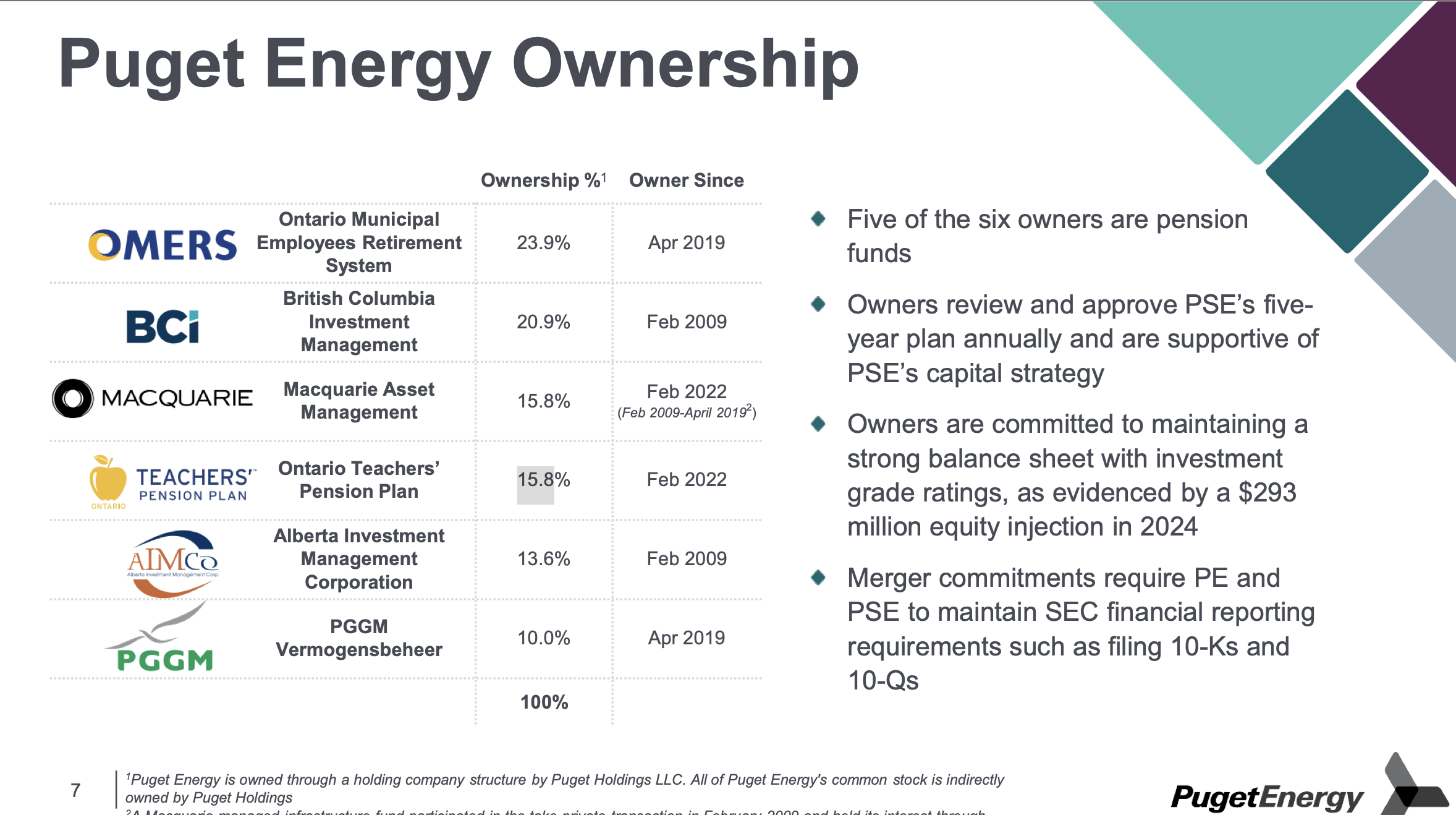
High Gas and Electric Rates sustain PSE's profits
The funds' objective is shareholder return, and PSE delivered: $175.9 million in dividends in 2024 and $62.9 million in 2025, even as it told regulators it needed double-digit rate increases. Executive pay followed the same path. CEO Mary Kipp's total compensation rose 30% in one year, from $6,399,210 in 2024 to $9,204,291 in 2025 — roughly 80 times the median PSE worker's salary. Ordinary ratepayers, meanwhile, absorbed a ~12% electric increase in January 2026 and face requests for roughly 17% more in 2027, plus smaller hikes through 2029.
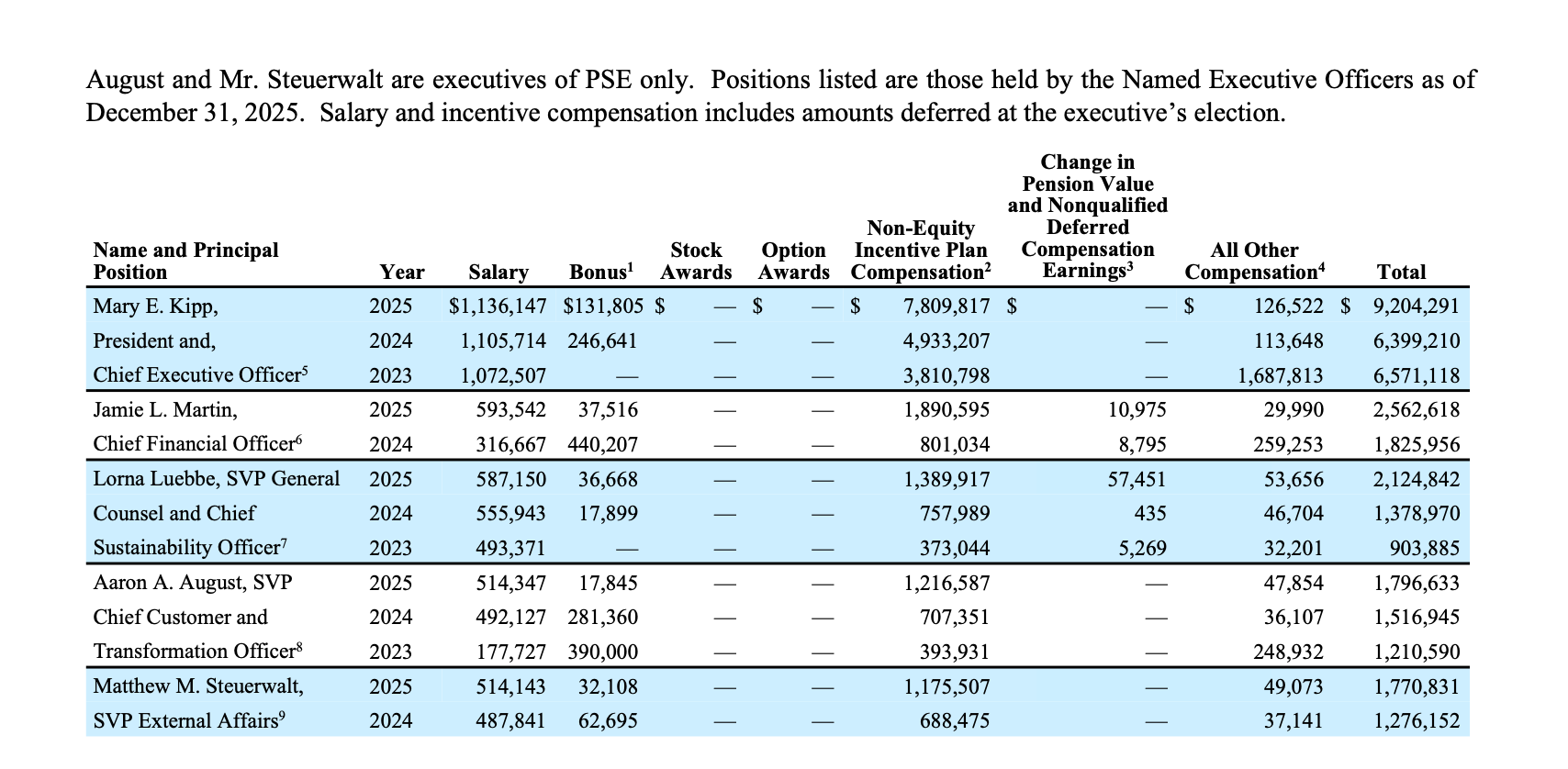
Customers subsidize PSE's high power costs and capital expenditures
PSE generates only about half its power, while the rest of it is purchased from external providers. These long term contracts are with five Columbia River dams, operated by the same public utility districts (Chelan, Douglas, Grant) whose cheap power has been attractive for large scale data centers.
Partly because of increased demand from data centers, PSE has to pay a premium on external power, where they spent $555.5 million on purchased electricity in Q1 2026, up 45.6% from $381.5 million a year earlier. A Federal Reserve Bank of Dallas working paper highlights how data centers have been responsible for "...a $5 increase in competitive wholesale prices in SRVC, a greater than 10% increase, and a $4 increase in NWPP." Rather than absorbing the increased cost of power, PSE proposes to pass 100% of it to customers in the form of double digit rate increases, something that is currently being challenged by the Washington State Attorney general's office.

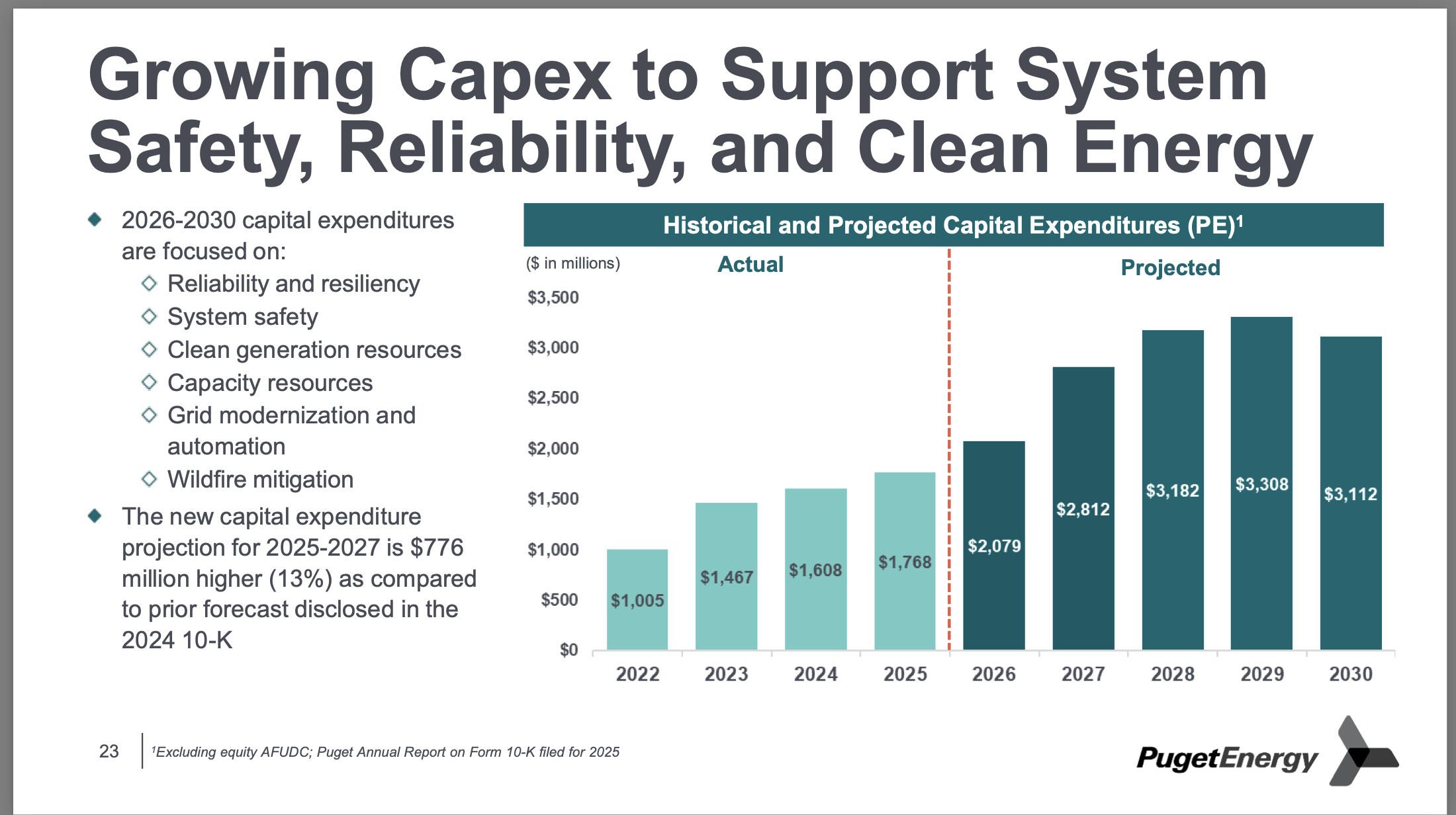
PSE has $14.5 billion in spending and ratepayers are financing it
PSE plans roughly $14.5 billion in capital expenditures between 2026 and 2030, nearly double its 2022 spending. Its investor deck shows the latest forecast runs $776 million, 13% above what was disclosed to investors a year earlier. The categories are broad: 'reliability,' 'clean generation,' 'grid modernization', and expenses are not broken down by project.
Meanwhile, dividends remain a priority, with PSE delivering $238.8 million over 2024-2025, in addition to the capital expenditure financed largely through bonds. The interest and principal for those bonds are paid by customers through their electric and gas bills, after PSE retains its profit. The foreign pension funds deliver dividend and profit and ratepayers sustain the debt.
What else are they spending customer money on?
PSE also spends customer revenue on projects that are not related to providing services, including robust advertising and public relations, and lobbying the state and federal government.
A ton of ads to justify why they're ripping off ratepayers
Even though one may be a Seattle City Light customer, Puget Sound Energy's Instagram ads still land on their feed. In addition to spending money on social media ads, PSE partnered with a high-end production company to produce commercials.


Lobbyists
In 2025, PSE spent $653,000 for lobbyists to influence state leaders when it comes to writing legislation.
Campaign and PAC Contributions
There's a high chance your local leader receives money from PSE. Washington's campaign disclosure website highlights just how much each state leader or candidate received in campaign finances from PSE, most of which is funneled through local PACs.
Their top recipient this year has been Jamie Pedersen, the State Senate Majority leader of Washington's 43rd district. He is being challenged by Hannah Sabio-Howell, whose campaign page says she "won’t take money from Corporate PACs or Special Interests." (As of 7/8, Pedersen leads with 68% of the votes, with Sabio-Howell with 21%).

PSE also contributes to various corporate PACs in Washington State. In 2026, they've contributed $60,000 to these PACs.
One of these is the Jobs PACS, also funded by tens of thousands of dollars from health insurance companies, data center companies, and oil companies.

What now?
How the public can push back:
The UTC Board, the state agency responsible for approving or modifying the rate hike, is inviting the public to two meetings:
1) In-Person at 621 Woodland Square Loop S.E., Room 110 in Lacey, 6PM on 9/29
2) Virtual Public Comment Hearing, 6PM on 10/7
Meeting ID: 882 1351 8474, Pw: 226995
While UTC could lower the requested rate increase, major changes need to also come from elected leaders willing to pass a statewide data center moratorium and additional regulation reducing the max "Return on Equity" private utility providers can request
Finally, ratepayers would be better served if PSE were to become a publicly owned utility company where the objective would be reducing electric rates for Washingtonians instead of increasing profit for foreign shareholders.